Address
304 North Cardinal St.
Dorchester Center, MA 02124
Work Hours
Monday to Friday: 7AM - 7PM
Weekend: 10AM - 5PM

Address
304 North Cardinal St.
Dorchester Center, MA 02124
Work Hours
Monday to Friday: 7AM - 7PM
Weekend: 10AM - 5PM
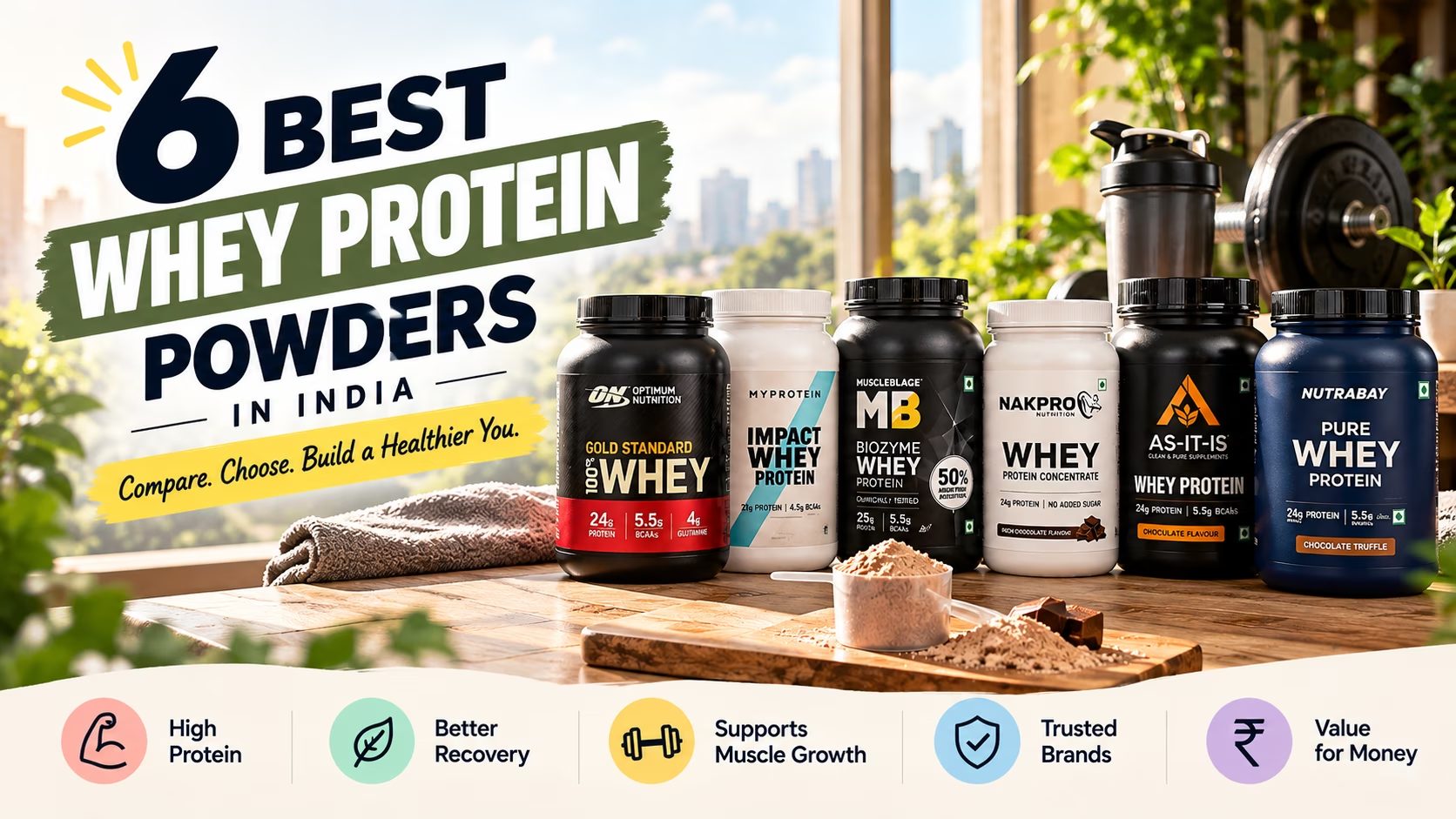

You decide to start working out. Maybe you want to build muscle, gain healthy weight, improve your strength, or simply make sure you are eating well. You start paying attention to your meals. Then the same advice begins following you everywhere: buy protein powder.
One person recommends a famous international brand. Another swears by a cheaper Indian product. A trainer says you need isolate. An influencer says their formula absorbs faster. The packaging promises better digestion, faster recovery, more muscle, and sometimes a level of scientific certainty that sounds almost too good to be true.
Then comes the price. One tub costs ₹1,500. Another costs ₹5,000 or more. Both claim to help you build muscle. What exactly are you paying for?
This guide is designed to do the shopping homework with you. We will ask the questions a careful buyer should ask, explain how to interpret the answers, and compare products by the kind of person they may suit. We will also separate four things that are often mixed together in supplement marketing: scientific evidence, product specifications, independent testing, and customer experience.
The goal is not to crown one brand as the universal winner. It is to help you buy the right product for your needs, or realise that you do not need a supplement at all.
Research note: This guide prioritises scientific papers, government and medical sources, official product labels, independent testing registers, certification databases, and public customer reviews on product or retailer pages. Reviews are used only as clues about taste, mixability and tolerance, not as proof of health benefits. No blog or Reddit opinion is treated as evidence. Prices and product formulas change, so verify the live listing, exact flavour, batch and label before ordering.
Before comparing brands, ask a more useful question: What problem am I trying to solve?
Protein powder is not a requirement for going to the gym. It is a convenient food supplement. It can be helpful when your usual diet does not provide enough protein, when you struggle to prepare another meal, or when you need a compact source of protein around a busy schedule.
But if you already meet your needs through foods such as dal, chana, rajma, soy, paneer, curd, milk, eggs, fish or meat, a tub may add cost without adding much value.

A quick self-check:
If the real issue is that you skip meals, eat too little overall, or do not train consistently, buying a premium whey is unlikely to solve it. If you want to know about protein options and supplements other than whey, then read our article best protein powder in india.
There is no single target that suits every person. Needs depend on body size, age, activity, training goals, health and total energy intake. For healthy adults who train with weights, sports nutrition research often discusses a daily intake around 1.4-2.0 grams per kilogram of body weight, while a major meta-analysis found that the average additional benefit for resistance-training gains tended to level off around 1.6 g/kg/day. That is a guide, not a mandatory number for everyone.
For example, a healthy 70 kg adult who trains regularly might use 1.6 g/kg as a planning reference: 70 × 1.6 = 112 grams of protein per day. That does not mean all 112 grams must come from powder. Food counts too.
If you have kidney disease, another condition that affects your diet, are recovering from illness, are pregnant, or are choosing a supplement for a child or teenager, get personalised advice from a qualified clinician or dietitian instead of copying a gym target.
Sources: NIH Office of Dietary Supplements: Exercise and Athletic Performance; Morton et al., British Journal of Sports Medicine (2018), systematic review and meta-analysis.
Whey protein comes from milk. During cheese-making, milk separates into solid curds and a liquid called whey. Whey contains water, lactose, minerals and proteins. Manufacturers filter and process it to concentrate the protein, then dry it into powder.

So whey is milk-derived protein, not an anabolic steroid. It is processed, but “processed” does not automatically mean harmful. The meaningful questions are what the finished product contains, how much protein it provides, whether the quality claims are credible, and whether it suits you.
Your digestive system breaks protein into amino acids and smaller peptides. Your body uses those building blocks for normal maintenance and repair, including muscle tissue. Whey contains all nine essential amino acids and is rich in leucine, which plays a role in signalling muscle protein synthesis.
That makes whey a convenient source of high-quality protein. It does not make it magic. Muscle growth still depends on appropriate resistance training, enough total food and protein, recovery, sleep and consistency.
A systematic review of 49 studies involving 1,863 healthy adults found that protein supplementation can support additional gains in muscle and strength when combined with resistance training. It did not establish that one commercial brand consistently builds more muscle than another when overall protein intake and training are comparable.
Source: Morton et al., British Journal of Sports Medicine (2018), full paper.
For many healthy adults, whey can be a convenient way to meet protein needs. But no supplement is automatically right for every person.
Lactose intolerance means you have difficulty digesting lactose, the sugar naturally found in milk. Whey concentrate usually contains more lactose than whey isolate, although the exact amount varies by product. Some people tolerate concentrate; others notice gas, bloating or diarrhoea.
An isolate with low lactose may be worth trying if lactose is the issue. Check the actual label rather than assuming every isolate is lactose-free. A smaller serving with water may also be easier to tolerate, but persistent symptoms should not be ignored.
Avoid whey. Whey is a milk protein, and a lactose-free product does not solve a milk protein allergy. Speak with a clinician about a suitable alternative.
Do not follow a generic high-protein gym plan without medical advice. Protein requirements can differ depending on kidney function, treatment and other health factors. The National Kidney Foundation provides guidance on nutrition and kidney disease.
Do not assume that all digestive discomfort is caused by lactose or that a powder marketed as “easy to digest” will fix it. Potential contributors include serving size, lactose, sweeteners, added fibres, flavour ingredients or an unrelated health issue. Try to identify the trigger carefully, and seek medical advice for persistent symptoms.
It is not accurate to say that ordinary whey automatically damages the kidneys of healthy adults. It is equally unwise to conclude that unlimited protein intake is harmless for every person indefinitely. Total intake, health status, product quality and individual circumstances matter.
Sources: NIH Office of Dietary Supplements; National Kidney Foundation: Nutrition and kidney disease.
These terms describe how whey is processed. They are not a simple ladder from “bad” to “best.”

Concentrate retains protein along with varying amounts of lactose, fat and other milk components. WPC80 is a grade that is roughly 80% protein by weight as a raw ingredient; the finished flavoured product may have a different percentage.
Often makes sense if: you tolerate dairy, want value for money, and do not need to minimise lactose or fat.
Think twice if: lactose reliably triggers symptoms or the product has a low protein percentage once you account for its full serving size.
Isolate undergoes more processing to remove much of the lactose and fat. It generally provides a higher percentage of protein per gram of powder.
Often makes sense if: you need to reduce lactose, want more protein in a smaller serving, or prefer a leaner formula.
Think twice if: the extra price buys you no practical benefit. Isolate is not automatically better for muscle growth, and it is not suitable for a milk protein allergy.
Hydrolysed whey has been treated with enzymes that break some proteins into smaller peptides. It is often marketed as faster-absorbing or easier to digest.
What to ask: Is there credible evidence that this exact product gives me a meaningful advantage, or am I paying for a technical-sounding process? Faster digestion does not automatically translate into better long-term muscle growth.
Practical rule: choose concentrate, isolate or hydrolysed whey based on your digestion, budget, label and goals. Do not pay more simply because the product sounds more advanced.
Not for everyone. Whey has a strong essential-amino-acid profile and is rich in leucine, but plant protein can also support muscle growth when the total amount and amino-acid balance are adequate.
A 2021 systematic review and meta-analysis compared animal and plant protein in randomised controlled trials. Results varied with the population and training context; it does not support the blanket claim that plant protein cannot build muscle effectively.
Choose plant protein if you are vegan, avoid dairy, dislike whey, or simply find a plant-based product works better for you. You do not need to buy whey to make progress.
Source: Lim et al., Nutrients (2021), systematic review and meta-analysis.
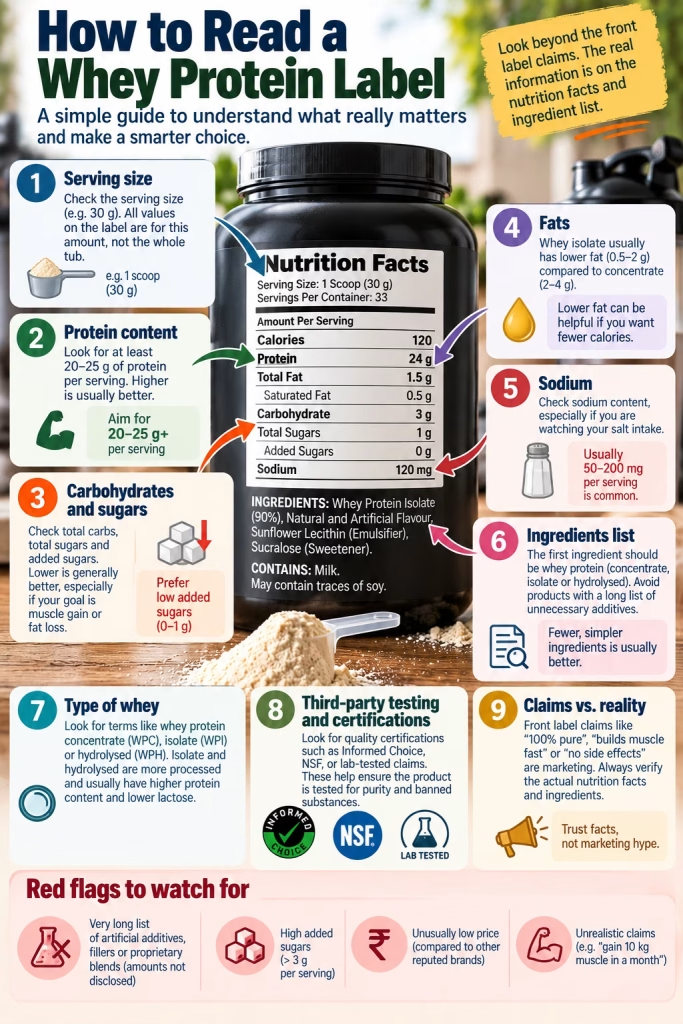
Now we get to the part that makes products genuinely comparable.
Do not confuse scoop weight with protein content. A 45 g serving is not necessarily 45 g of protein. Read the nutrition panel and compare protein per 100 g of powder as well as protein per serving.
A product with a 45 g scoop and 24 g protein supplies about 53% protein by powder weight. Another with a 30 g scoop and 24 g protein supplies 80%. The first might still fit your needs, but you should understand what makes up the rest of the serving: carbohydrate, fat, flavouring, minerals, enzymes or other ingredients.
Also check the exact flavour. Different flavours of the same product can have different nutrition numbers.
Check the ingredient list for added sugar, sweeteners, flavourings, thickeners, added fibres, enzymes and other ingredients. These are not automatically bad. They simply matter if you have a preference, intolerance or reason to avoid them.
Unflavoured powder can be useful if you want to mix it into oats or a smoothie, or want fewer flavour ingredients. But a short ingredient list is not proof that a product is safer or more effective. Testing and manufacturing quality still matter.
Amino spiking is a term used when a product’s apparent protein result may be inflated by adding free amino acids or other nitrogen-containing compounds that can interfere with some protein measurement methods. A protein result based only on nitrogen can be misleading if the method does not distinguish intact protein from other nitrogen sources.
Do not rely on a slogan saying “no amino spiking.” Look for a credible test report that identifies the product, batch, laboratory and relevant test results. We have covered more about amino spiking in this article.
“Lab tested” is not enough on its own. Look for:
A pass for one batch is a useful signal, not a lifetime guarantee. It does not automatically apply to another flavour, another formula or the batch currently in your cart.
Certification can be useful, but the scope matters. For example, sports-focused programmes may screen for banned substances. That is especially relevant to tested athletes, but it does not necessarily prove every nutrition claim or guarantee the absence of every possible contaminant.
Likewise, a food licence or regulatory-compliance statement is important, but it is not the same as an independent public laboratory report for the tub you are about to buy.
Sources: Informed Choice certified-products register; FSSAI: Health Supplements and Nutraceuticals; Trustified testing register.
Compare the cost per 25 g of protein, not just the price per tub.
Cost per 25 g of protein = pack price ÷ total grams of protein in the pack × 25
Example: a 1 kg pack costs ₹2,000 and provides 75 g of protein per 100 g of powder. The pack contains approximately 750 g of protein.
₹2,000 ÷ 750 × 25 = about ₹66.67 per 25 g of protein.
If another product is cheaper per tub but provides less protein per serving, has a larger serving size, or includes more non-protein ingredients, the headline price may mislead you. Use the actual label and current price for your calculation.
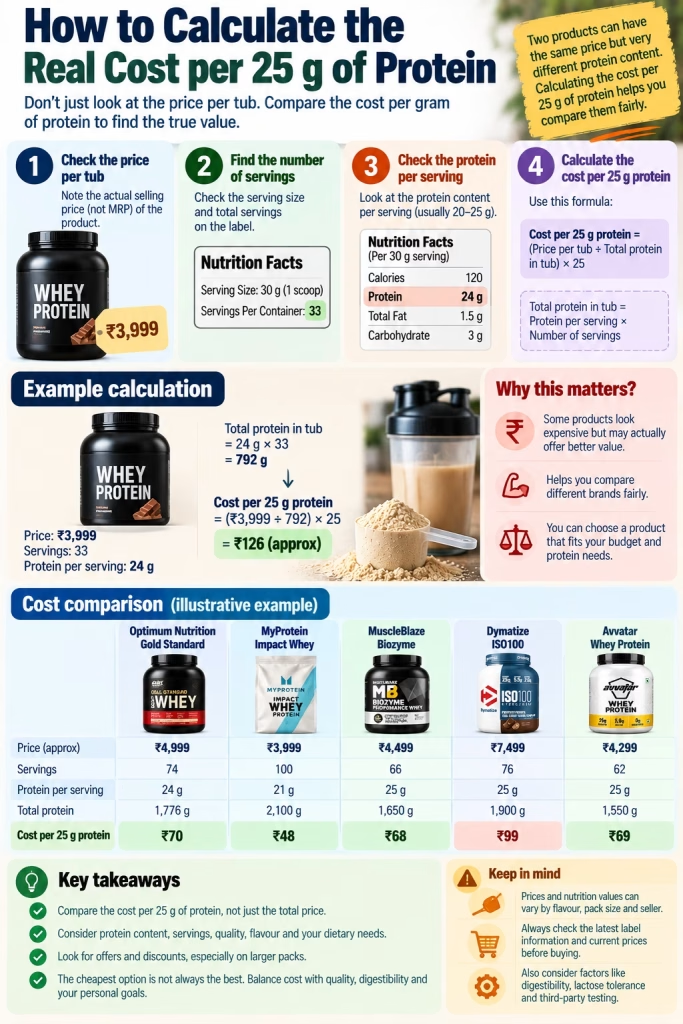
This is a value metric, not a full quality score. A product may cost more because of certification, ingredients, manufacturing, distribution or branding. Decide which of those features matters to you.
Public reviews can help, but only if you ask them the right questions.
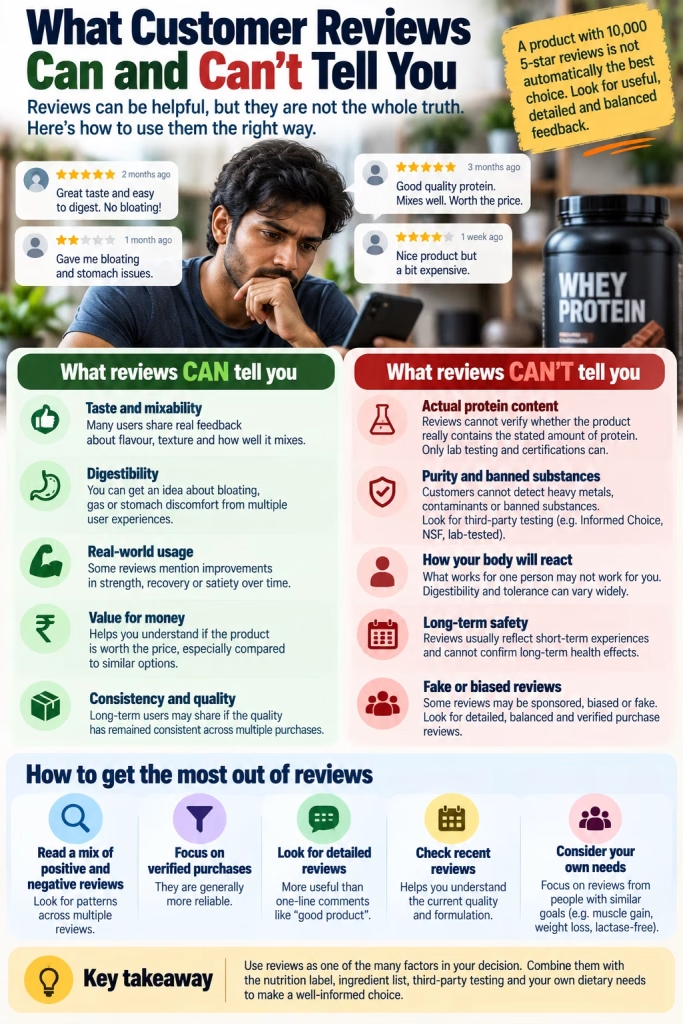
Useful things to look for across a substantial number of reviews:
What reviews cannot reliably prove:
Reviews are self-selected, and people differ in diet, expectations, serving size and digestive tolerance. Some review pages combine flavours or pack sizes. A 4.8 rating from a small number of reviews is not directly comparable with a 4.4 rating from thousands.
For this reason, the product profiles below treat reviews as a secondary usability signal, not as a scientific score. Check current reviews for the exact flavour and seller before buying.
There is no credible basis for ranking these six by muscle growth as if they had all been tested head-to-head under the same conditions. The useful comparison is what each product offers, who might benefit, what trade-offs to notice, and what evidence you can verify.
Prices are dynamic and depend on pack size, flavour, sale and seller. Rather than pretending a price will remain fixed, check the official page linked for each product and calculate cost per 25 g of protein. Testing entries below refer to named batches and publication dates; verify the current batch before purchasing.

Best starting point for: buyers prioritising budget, provided they understand the serving composition.
What the label says: Nakpro’s official page lists a 1 kg pack with a 45 g serving and 24 g protein per serving. It describes the formula as a whey blend with added vitamins, minerals and an enzyme blend. That means the serving is not 100% protein, so compare it on cost per gram of actual protein rather than price per kilogram of powder.
Testing evidence: Trustified’s register lists Nakpro Impact Whey Protein batch IMK1808A, tested by Eurofins and marked passed, published 31 January 2026. That is a useful product-specific data point, but make sure the batch and variant you buy match the report.
Customer-experience check: Look for recent reviews of the exact flavour you intend to buy. Taste and mixability can vary by flavour, and user comments about results should not be treated as proof that the powder is effective or ineffective.
Trade-off: Its large serving size means the headline “24 g protein” is delivered in 45 g of powder. That is not automatically a problem, but buyers should understand it. Added ingredients may be useful to some buyers and unnecessary to others.
What reviews add: The official page has both value-oriented praise and a complaint about a chalky chocolate taste; Nykaa’s Malai Kulfi reviews are more positive about taste and mixability. Amazon’s digestion feedback is mixed. This makes flavour-specific checking particularly important. Official reviews · Nykaa · Amazon.
Consider it if: your budget is tight and the current cost per 25 g of protein is competitive.
Compare it with: AS-IT-IS WPC80 if you prefer a simpler concentrate, or Naturaltein isolate if low lactose is more important than price.
Links: Nakpro official product page; Trustified batch register.
Best for: buyers who want a straightforward, unflavoured concentrate and tolerate dairy.
What the label says: The official product page describes it as an unflavoured concentrate, with 24 g protein in a serving and no added flavouring or enzyme blend in the listed formula. Verify the exact pack and current nutrition panel before comparing it with other products.
Testing evidence: Trustified lists AS-IT-IS Whey Protein Concentrate 80%, batch WPC 50818, tested by Eurofins and marked passed, published 27 November 2025.
Why the simpler formula may appeal: Unflavoured powder can be easier to add to oats, smoothies or recipes without changing their flavour as much. A single-ingredient product can also make it easier to identify what you are consuming.
Trade-off: Concentrate generally contains more lactose than isolate. If milk causes digestive symptoms, this may not be the right choice. “Simple ingredients” also does not remove the need to check the label, authenticity and current batch.
What reviews add: Reviewers often appreciate the value and simplicity, but reports on smell, taste and mixability vary. Unflavoured does not mean tasteless, so consider trying a smaller pack if you are sensitive to the flavour of plain whey. Flipkart reviews.
Consider it if: you want a basic concentrate and value transparency over flavour options or extra features.
Compare it with: The Whole Truth Raw Whey Concentrate, which has a similarly simple positioning but includes a small amount of bromelain according to its product page.
Links: AS-IT-IS official product page; Trustified batch register.
Best for: buyers looking for a higher-protein-per-gram isolate and a product marketed as low-lactose.
What the label says: Naturaltein’s official page advertises 30 g protein per serving and describes the product as an isolate with natural flavouring and stevia. Because the same page describes a 30 g serving, do not simply assume that 30 g of powder contains 30 g of protein: check the detailed nutrition panel on the pack and confirm the serving size before buying. The page also markets it as lactose-free and easy on the stomach. Treat the lactose and digestion wording as product claims; check the current label and ask the manufacturer for clarification if you need strict lactose avoidance.
Testing evidence: Trustified lists Naturaltein Whey Protein Isolate batch NWPIM250501, tested by Eurofins and marked passed, published 29 January 2026.
Why it may suit some buyers: Isolate is usually more protein-dense and lower in lactose than concentrate. That can make it a reasonable option if you tolerate some dairy products poorly but do not have a milk protein allergy.
Trade-off: Isolate often costs more per gram of powder. If you tolerate concentrate comfortably, the premium may not provide a meaningful benefit. A product marketed as “easy on stomach” cannot guarantee that you personally will tolerate it.
What reviews add: The visible verified-purchase comments tend to praise mild sweetness, smooth texture and easy mixing, with some reports of stomach comfort. The sample is limited and cannot guarantee your tolerance. Flipkart reviews.
Consider it if: lactose is a concern, you want a leaner formula, and the current cost per 25 g of protein fits your budget.
Do not use it for: a milk protein allergy. Whey isolate is still milk-derived.
Links: Naturaltein official product page; Trustified batch register.
Best for: buyers interested in a formulated whey product with added digestive enzymes, provided they do not mistake marketing claims for proven superiority.
What the label says: The product page lists 25 g protein per 36 g serving and describes a concentrate-based formula with an enzyme blend. The ingredient list may include flavourings, sweeteners and other additions depending on the variant. Read the exact label, especially if you are sensitive to sweeteners or added fibres.
Testing evidence: Trustified lists Biozyme Performance Whey batch MMBPWCH055, tested by Eurofins and marked passed, published 4 October 2025. That is useful evidence for that batch and test scope.
The claim to scrutinise: The brand promotes enhanced protein absorption. An enzyme blend may be part of the formulation, but a marketing claim about absorption does not automatically establish better long-term muscle growth, less bloating for every user, or superiority over a simpler whey. Those are separate questions requiring appropriate evidence.
Customer-experience check: Read recent comments about taste, sweetness, mixability and tolerance for the exact flavour. Ratings can vary significantly by retailer, variant and time, so do not treat one displayed star score as a scientific verdict.
What reviews add: Comments include repeat buyers praising taste and tolerance, alongside complaints that some flavours are too sweet. A small retailer review sample also included a packaging-integrity complaint, so inspect the seal and buy from a reputable seller. Nykaa reviews · Apollo Pharmacy reviews.
Consider it if: you like the flavour and formulation, tolerate its ingredients, and the price makes sense to you.
Compare it with: plain concentrate or isolate before paying extra for digestion-related features.
Links: MuscleBlaze official website; Trustified product-specific test.
Best for: buyers who value an established sports-nutrition product and a recognised sports-focused certification programme.
What the label says: The India product page lists 24 g protein per serving. The formula combines whey protein sources, including isolate and concentrate; check the exact flavour label for its full ingredients and nutrition information.
Certification evidence: Optimum Nutrition Gold Standard 100% Whey appears in the Informed Choice certified-products register. This is a relevant signal for buyers concerned about sports supplement screening, especially tested athletes. Read the programme’s scope rather than assuming certification covers every possible quality question.
Customer-experience check: Public product reviews often discuss flavour, mixability and price. Those are useful for judging whether you are likely to enjoy using it, but they cannot establish superior muscle gains. Verify the seller and seal because authenticity matters with premium imported products.
Trade-off: It can cost more than local options. The premium may be worth it to a buyer who values the certification and familiar product experience, but not automatically to someone who only needs an affordable protein source.
What reviews add: Official India reviews are mostly positive about taste and mixability in the listings checked. Some buyers describe the product as expensive, and taste strength is a matter of preference. These are convenience signals, not evidence of better results. Official reviews.
Consider it if: sports-focused certification is important to you and the authentic product is available at a price you can sustain.
Compare it with: a locally available product with a recent, matching batch report. Do not assume that international branding alone guarantees better value.
Links: Optimum Nutrition India; Informed Choice certified-products register.
Best for: buyers who want a relatively simple, unflavoured powder for shakes, oats or recipes.
What the label says: The product page for the unflavoured whey concentrate lists whey protein concentrate as the main ingredient, with a small amount of bromelain. It describes the protein concentration as around 80%. Check the live page and pack label because product names, formulas and sizes can change.
Testing evidence: Trustified lists The Whole Truth Concentrate batch TWTWCU0112F2, tested by Eurofins and marked passed, published 4 July 2025. Confirm that the product and batch you are buying correspond to the record.
Customer-experience check: The official product page displays a large number of verified reviews. These can help you investigate mixability, taste neutrality and how people use it in food. They do not prove that a simpler ingredient list makes the product safer or more effective than a competitor.
Trade-off: A clean-looking label is a preference, not a special physiological advantage. Compare its price per 25 g of protein with other unflavoured concentrates.
What reviews add: Reviewers commonly describe the unflavoured powder as neutral or milk-powder-like. Many praise mixability, but some mention foam or small lumps. Amazon reviews · Flipkart reviews.
Consider it if: you prefer to control flavour yourself and are happy paying the current price for that convenience.
Links: The Whole Truth official product page; Trustified batch register.
Avvatar Isorich deserves a place on a shortlist, particularly for buyers comparing isolate options. Trustified lists Avvatar Isorich batch AI6025AI9G, tested by Eurofins and marked passed, published 20 January 2026. The official website lists several pack sizes and flavours, with prices that can be substantially higher than concentrate products.
Why it did not replace every product above: the goal is not to list every product with a test record. The six main profiles represent different buying priorities: value, simplicity, low-lactose needs, an enzyme-containing formula, sports-focused certification, and an unflavoured option. Avvatar Isorich is a useful additional comparison if you specifically want an isolate. Verify the exact variant, current batch, label and price before deciding.
Links: Avvatar Isorich official page; Trustified testing register.
This is where the wording on tubs can become confusing.
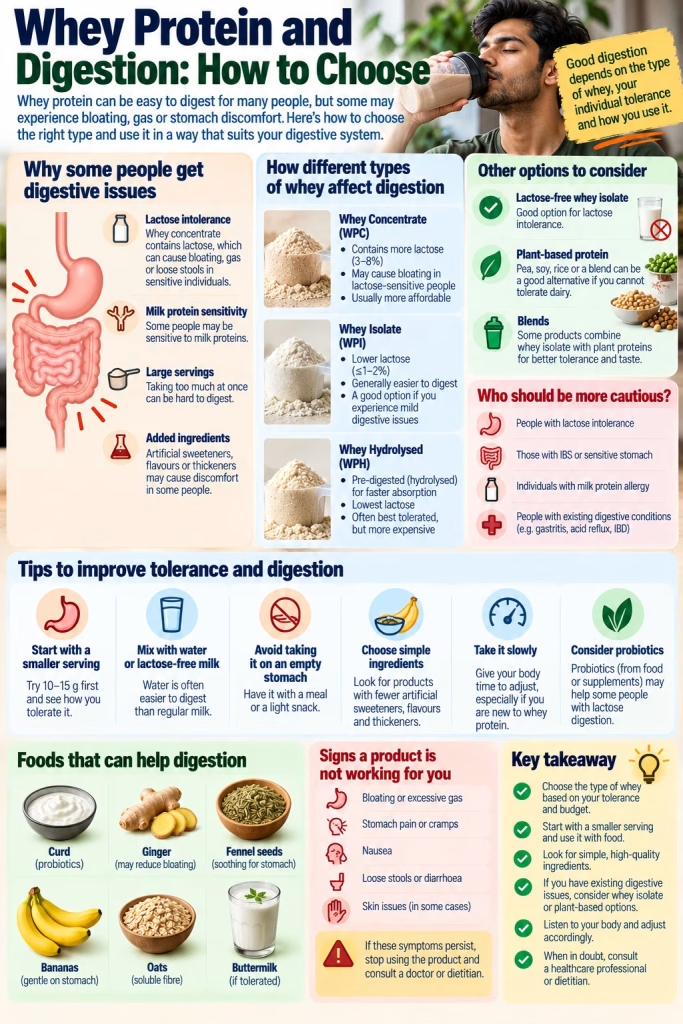
A product can be lower in lactose, include digestive enzymes, or be marketed as easy to digest. Those features may matter to some people, but they do not guarantee a symptom-free experience.
Use this decision path:
A digestive enzyme blend is not a guarantee against bloating. A product with fewer ingredients is not guaranteed to be easier for everyone. And “faster absorption” is not the same as “better results.”
Age can change overall nutrition needs, appetite, health considerations and the importance of maintaining muscle. It does not create a simple rule that younger people need concentrate while older people need isolate, or that a less concentrated powder is better absorbed by a particular age group.
Older adults may benefit from adequate protein and resistance exercise to help maintain muscle and function. Some may find a drink convenient if appetite is low or chewing and meal preparation are difficult. But the amount and type should fit their diet, health and medication context. People with kidney disease or complex health conditions need individual guidance.
For children and teenagers, do not simply apply adult gym supplement advice. A food-first approach and advice from a qualified healthcare professional are more appropriate.
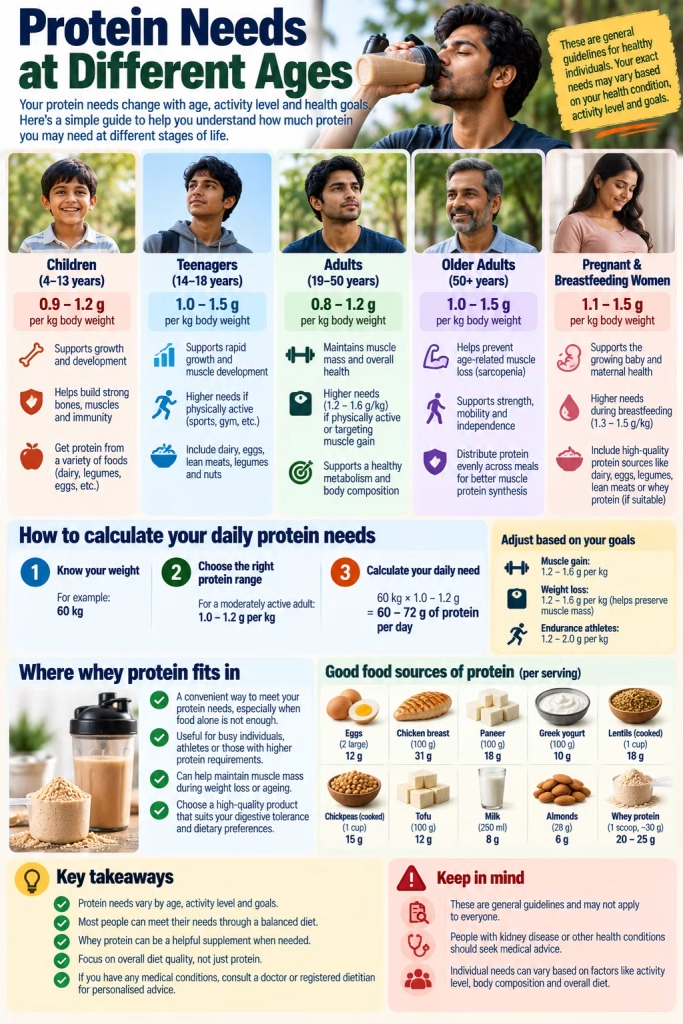
Source: PROT-AGE Study Group position paper on protein intake in older adults.
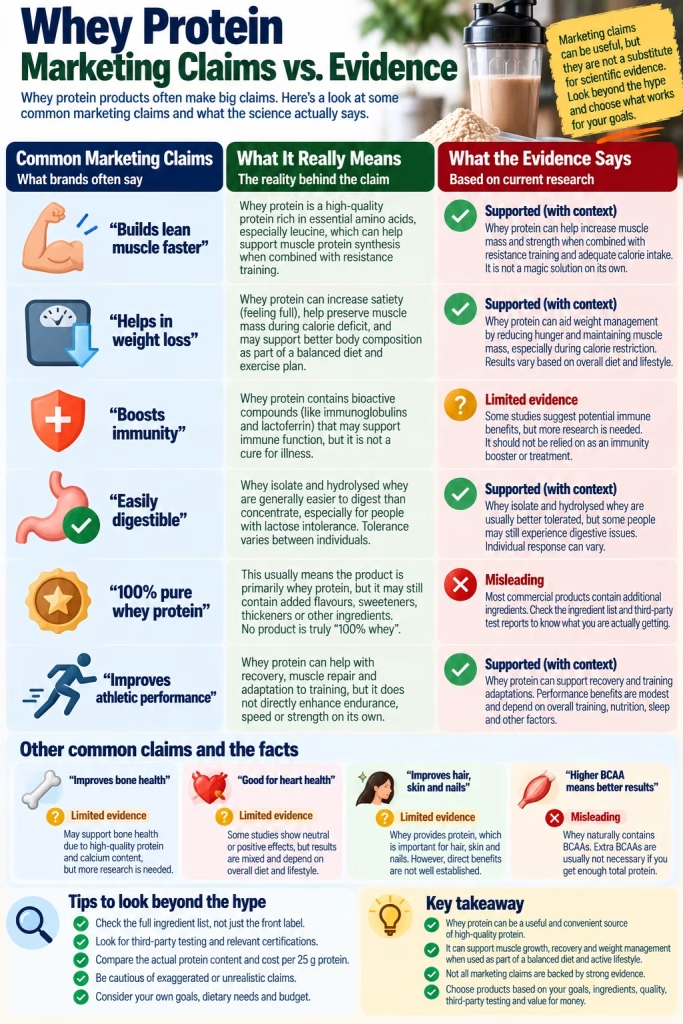
Ask: Compared with what product? In what study? How many people? Was absorption measured, or was a different outcome measured? Did the study show more muscle or strength over time?
A difference in one digestion or absorption measure does not automatically mean a meaningful difference in results.
Ask for the study or test report. Was the finished product tested in a well-designed human trial, or does the phrase refer to an ingredient or a laboratory measurement? What was the comparison group? Was the outcome relevant to your goal?
These may be useful label details, but they do not tell you whether the product is authentic, independently tested, tolerable or worth its price.
These words may describe sourcing or marketing position, but they are not substitutes for the nutrition panel and credible testing. Ask what practical advantage the claim gives you and whether the evidence supports it.
No powder can compensate for insufficient training, energy, protein or sleep. A product may help you meet protein needs, but that is different from proving that its special formula gives you superior results.
It is reasonable to be careful about quality without assuming every product is unsafe.
The Citizens Protein Project published research analysing protein supplements sold in India. Its studies reported problems in some sampled products, including discrepancies between labelled and measured protein and findings involving other tested parameters. The papers are a reason to take independent testing seriously, not proof that every Indian brand or every product is poor quality.
A test result applies to the samples, products and methods used. The right response is not to panic or to trust a brand blindly. It is to look for transparent, product-specific evidence and buy from a reliable source.
Sources: Citizens Protein Project, 2024; The Citizens Protein Project 2, 2025.
Use the following as a shortlist, not a universal ranking.
| If your main priority is… | Start by comparing… | Why | What to check before buying |
|---|---|---|---|
| Keeping costs down | Nakpro Impact; AS-IT-IS WPC80 | Lets you compare value-focused blend versus simpler concentrate | Cost per 25 g protein, actual protein percentage, batch evidence |
| A simple unflavoured formula | AS-IT-IS WPC80; The Whole Truth Raw Whey Concentrate | Useful for people who want to mix powder into food or choose their own flavour | Lactose tolerance, live price, ingredients and batch |
| Lower lactose / higher protein density | Naturaltein Whey Isolate; Avvatar Isorich | Isolates usually contain less lactose and more protein per gram of powder | Exact lactose claim, current label, allergy status and price |
| A formula with added digestive enzymes | MuscleBlaze Biozyme Performance Whey | Includes an enzyme blend, but its marketing claims need separate scrutiny | Ingredient tolerance, serving size, batch report, no assumption of guaranteed digestion benefits |
| Sports-focused certification | Optimum Nutrition Gold Standard 100% Whey | Appears in the Informed Choice certified-products register | Verify current product listing, seller authenticity and price |
| Plant-based / no dairy | Soy isolate or a suitable pea/rice blend | Can supply protein without whey | Protein per serving, amino-acid profile, ingredients and testing |
If you are a healthy adult, tolerate dairy and simply need more protein, start by comparing two well-tested concentrates. Use the cost per 25 g of protein, ingredient list and batch evidence to choose. Do not assume that the most expensive isolate will build more muscle.
If lactose is the likely problem, compare isolates and confirm the actual lactose information. If you have a milk protein allergy, choose a non-dairy alternative instead.
If you compete in tested sport, a recognised banned-substance certification may deserve more weight. If taste or digestion determines whether you will use a product consistently, read recent reviews of the exact flavour, but do not treat reviews as proof of clinical benefit.
And if food already meets your needs, save the money.
Many healthy adults use whey daily to help meet protein needs. Suitability depends on total intake, product quality, tolerance and health conditions. More is not automatically better.
Ordinary whey does not automatically damage the kidneys of healthy adults. People with kidney disease may need specific protein guidance from their healthcare team.
No. Isolate usually has a higher protein percentage and less lactose, but it costs more. If you tolerate concentrate and meet your protein needs, isolate may offer little practical advantage.
Not by default. It has undergone additional processing, but faster digestion does not automatically prove better long-term muscle or strength outcomes.
There is no guaranteed answer. Lactose, serving size, sweeteners, fibres and other ingredients can all matter, and symptoms can have unrelated causes. Isolate may help some people with lactose intolerance, but it is not suitable for milk protein allergy. Persistent symptoms deserve medical advice.
Some older adults may find protein powder convenient, but the priority is adequate nutrition and maintaining strength and function. The right intake depends on health, diet and activity. Seek individual advice if there are medical conditions, especially kidney disease.
Yes. Resistance training, adequate total protein, enough energy, sleep and consistency matter far more than whether protein comes from a powder.
Useful for clues about taste, mixability, packaging and customer service. Not reliable proof of muscle growth, safety for everyone or superiority of one formula.
No. Compare the nutrition panel, independent testing, certification scope, authenticity and cost per 25 g of protein. Price alone proves very little.
No. Regulatory compliance matters, but it is not the same as a public independent lab report for every batch and every possible contaminant.
Health note: This article is for general education, not personal medical advice. If you have kidney disease, a milk protein allergy, persistent digestive symptoms or another condition that affects your diet, speak with a qualified healthcare professional before changing your protein intake.
Subscribe to get the latest posts sent to your email.