Address
304 North Cardinal St.
Dorchester Center, MA 02124
Work Hours
Monday to Friday: 7AM - 7PM
Weekend: 10AM - 5PM

Address
304 North Cardinal St.
Dorchester Center, MA 02124
Work Hours
Monday to Friday: 7AM - 7PM
Weekend: 10AM - 5PM

Which protein powder is actually worth buying in India? Whey, isolate, casein, plant-based — types explained, top brands rated, and red flags to avoid.
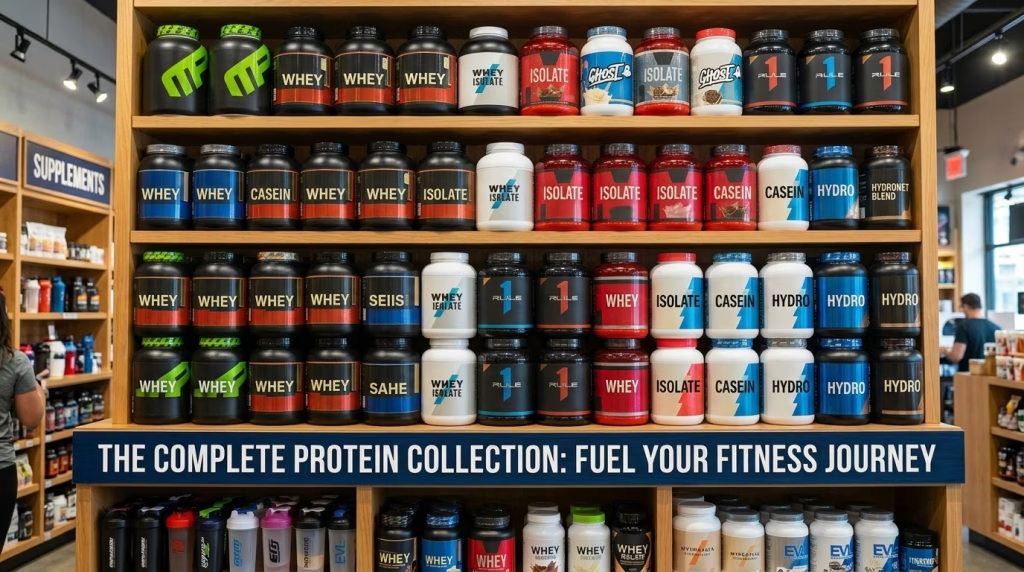
Walk into a GNC or scroll through any supplement store online and you’ll experience it, an aisle engineered to overwhelm. Hydrolysate, isolate, mass gainer, plant-based, keto-friendly, hormone-free, whey matrix. Every tub promises transformation. Most of them are delivering less than their label claims. The market for best protein powder India is enormous, largely unregulated, and full of products that exploit the gap between what consumers know and what brands print on their labels.
India’s sports nutrition market crossed ₹3,000 crore in 2024 and it’s growing fast. Which means more choice, but also more noise. The good news is that once you understand how to read a label, what the different protein types actually do, and which brands have earned their reputations, picking the right product becomes a lot more straightforward. This guide does that work for you.
Short on time? Skip to the Comparison Table or Brand Ratings.
Let’s start here, because the honest answer is: probably not, but maybe.
Whole foods remain the gold standard for protein intake. Chicken, eggs, paneer, dahi, dal, fish, etc come packaged with micronutrients, fibre, and satiety signals that no powder can fully replicate. If you’re already eating 3–4 protein-rich meals a day and hitting your targets, a supplement adds cost without much benefit.
But here’s where the gap calculation matters: most active Indians on a typical diet land somewhere between 60–80g of protein per day. If you’re training regularly and you weigh 70kg, you likely need 105–140g. That’s a 30–60g shortfall. Closing it through food alone means adding 200g of chicken breast, four eggs, or 300g of paneer to your daily intake. This is not always realistic when you’re traveling, working long hours, or don’t have cooking access.
That’s the legitimate use case for protein powder: a convenience tool to bridge a genuine gap, not a shortcut, not a meal replacement, and definitely not something that makes training optional.
If you’re still figuring out your daily protein needs, the Wellthify guides on how much protein you need for weight loss and high-protein Indian diet planning give you a clearer starting point before you spend anything on supplements.
This section could save you thousands of rupees. Most people skip it. What really matters is how much protein you get for the money you spend. Let’s compare two imaginary products.
| Product | Tub Size | Protein % | Total Protein | Price |
|---|---|---|---|---|
| A | 1 kg | 73% | 730 g | ₹2,500 |
| B | 2 kg | 70% | 1,400 g | ₹3,500 |
At first glance, Product A looks better because it says 73% protein compared to 70%.
But calculate the cost per gram of protein:
Although Product B has a slightly lower protein percentage, you’re getting almost twice as much protein for only ₹1,000 more. It’s the better value.
This is one of the dirtiest tricks in the supplement industry. Brands add cheap amino acids like taurine, glycine, creatine, glutamine to the powder. These amino acids register as protein on the standard nitrogen-based test (the Kjeldahl method) that most labs use. So a product with 20% of its “protein” coming from added free-form amino acids passes a basic lab test but doesn’t deliver the muscle protein synthesis benefits of actual whey or casein.

How to spot it: check the ingredient list for taurine, glycine, or creatine listed separately (not as part of a natural protein source). Better yet, look for third-party certification from Informed Sport or NSF Certified for Sport. These programmes specifically test for amino acid spiking.
Mass gainers and flavoured concentrates are the worst offenders. It’s not uncommon to find 15–25g of sugar per serving in some products, which are often labelled as “complex carbohydrates” but sourced from maltodextrin, which spikes blood sugar faster than table sugar. If your goal is body composition, this matters.
When a label says “Protein Matrix: 25g” without breaking down how much whey concentrate, casein, or egg white is in that 25g, that’s a proprietary blend. There’s almost never a good reason for it from a consumer perspective. It means the brand can use cheap fillers in quantities they don’t want you to see. Walk away.
Related to the above: a product can technically be “73% protein” while being poor value if the 73% is achieved with a tiny 28g scoop that’s designed to look high on the label but runs out quickly. Check total protein per tub and divide by price. That’s your actual rupee-per-gram-of-protein figure.
If a brand doesn’t carry Informed Sport or NSF certification, that’s not necessarily a deal-breaker. Although it means you’re relying on the brand’s word rather than independent verification.
Whey is a byproduct of cheese production. During processing, liquid whey is filtered and dried. Concentrate is the least processed form, retaining some fat, some lactose, and some immune-supporting compounds like immunoglobulins and lactoferrin.
Isolate undergoes additional cross-flow microfiltration or ion exchange processing to strip out most of the fat and lactose, leaving a purer protein concentrate.
Hydrolysate is whey that’s been pre-digested using enzymes that partially break down the protein chains before you consume it.
If your focus is only on whey protein, read this post on whey protein, its types and 6 best products compared.
Casein is the other major protein in milk. It forms a gel in the stomach and releases amino acids slowly over 5–7 hours, providing a sustained supply.
The research on pre-sleep casein is compelling. Res et al. (2012) showed that 40g of casein consumed before sleep increased muscle protein synthesis rates by 22% compared to placebo overnight, without adding excess body fat. Read more about this at Res PT et al., Med Sci Sports Exerc 2012
No single plant protein is complete on its own. Pea protein is high in lysine but lower in methionine. Brown rice protein is the inverse. Blended together in roughly a 70:30 ratio, they form a complete amino acid profile that’s surprisingly competitive with whey.
Tang et al. (2009) compared whey, soy, and other protein sources, establishing that leucine content and digestion speed are the primary drivers of muscle protein synthesis. Which is why a good pea+rice blend that approximates whey’s leucine content performs comparably. Read more about it at Tang JE et al., JISSN 2009
The gold standard protein before whey entered the picture. Egg white protein has a PDCAAS (Protein Digestibility-Corrected Amino Acid Score) of 1.0. That is the maximum possible score and a complete essential amino acid profile.
Type | Protein % | Absorption | Lactose | Price Range (₹/kg) | Best For |
|---|---|---|---|---|---|
| Whey Concentrate | 70–80% | Fast (60–90 min) | Moderate | ₹600–₹1,200 | Budget, beginners, bulking |
| Whey Isolate | 90–92% | Fast (50–80 min) | Minimal | ₹1,400–₹2,500 | Cutting, lactose intolerance |
| Whey Hydrolysate | 80–90% | Fastest (40–60 min) | Minimal | ₹2,500–₹4,000 | Elite performance, recovery |
| Casein | 75–85% | Slow (5–8 hours) | Low | ₹1,200–₹2,000 | Pre-sleep, muscle preservation |
| Plant-Based (Pea+Rice) | 70–80% | Moderate | None | ₹800–₹2,000 | Vegans, dairy-sensitive |
| Egg White | 80–85% | Medium | None | ₹1,500–₹2,800 | Dairy-free, complete protein |
Use this image for a quick reference

AS-IT-IS has done something unusual in the Indian supplement market: built a brand almost entirely on label honesty. Their unflavoured whey concentrate lists exactly one ingredient and that is “whey protein concentrate”, with no fillers, no artificial sweeteners, no proprietary blends. The protein per 100g is consistently 80%+ which compares favourably with international concentrates.
Wellthify Rating ★★★★★ (5/5)
The single best budget concentrate in India. If you want no-nonsense whey at an honest price, this is it. The unflavoured version mixes into anything whether it’s dahi, oats, smoothies without tasting of anything.
MuscleBlaze is India’s largest homegrown sports nutrition brand, and the Biozyme line is their attempt to differentiate on absorption. They use a proprietary enzyme blend (DigeZyme) claimed to enhance protein absorption by 50% versus standard whey. Independent testing has found the protein content to be largely as labelled, which for an Indian mass-market brand is noteworthy.
Wellthify Rating ★★★★☆ (4/5)
A solid Indian brand with better QC than most. The DigeZyme absorption claim is marketing-inflated, but the underlying product is decent. Good option for those who want an Indian brand with some credibility.
Nakpro is a newer entrant making a push on clean labels and transparency. Their Perform Whey Concentrate has a clean ingredient list, honest serving sizes, and competitive pricing. The brand is based in Bengaluru and has been more forthcoming about their sourcing than most new Indian brands.
Wellthify Rating ★★★☆☆ (3.5/5)
Promising brand with the right values. The lack of testing history keeps the rating conservative but worth considering, especially if you can find it at a discount.
ON Gold Standard is the benchmark product for whey protein globally for good reason. It’s been around since the 1990s, has been tested in dozens of independent studies, carries Informed Sport certification, and delivers consistent protein content batch to batch. The blend is primarily whey isolate with some concentrate, which is why it sits in both categories depending on how strict your definition is.
Wellthify Rating ★★★★★ (5/5)
The safest choice for anyone who values verified quality over price optimisation. If you’re an athlete subject to doping tests, this is on the short list.
ISO100 is a hydrolysed whey isolate, meaning it’s processed further than a standard isolate for faster absorption. It’s Informed Sport certified and consistently delivers 25g protein per 29g serving, which is one of the highest protein densities available in flavoured products. The hydrolysis makes it digest faster, though for most recreational trainees this speed difference is marginal.
Wellthify Rating ★★★★☆ (4.5/5)
Premium price, premium quality. Ideal for those who want an isolate with the added absorption speed of hydrolysate without jumping to an unflavoured hydrolysate. Worth the price if quality is your primary concern.
Isopure occupies a specific niche: 100% whey isolate with essentially zero carbohydrates and zero fat. Each serving delivers 25g of pure protein, making it ideal for those on very strict cutting protocols or ketogenic diets. It’s lactose-free, which also makes it accessible for people with lactose intolerance.
Wellthify Rating ★★★★☆ (4/5)
The best option for strict cutting or keto contexts where carbohydrate elimination matters. Taste is somewhat thin given the lack of any fat or carbs, but it mixes well.
MyProtein is a UK-based brand with aggressive pricing and wide distribution in India. Their Impact Whey Isolate offers 90%+ protein per 100g with a range of flavours, and the pricing is consistently among the best for isolates in the Indian market, especially during their frequent sales.
Wellthify Rating ★★★★☆ (4/5)
The value pick for isolates. If you’re not competing at an elite level and want an affordable, quality isolate, MyProtein is hard to beat, especially with discount codes, which are almost always available.
The same quality consistency ON delivers in their whey products applies here. Gold Standard Casein uses micellar casein which is the naturally occurring form in milk, considered superior to calcium caseinate for slow release. It’s the most studied casein product in the world and has appeared in multiple independent research studies.
Wellthify Rating ★★★★★ (5/5)
If you’re going to use a pre-sleep protein (and the evidence for it is solid), this is the product to use. Mixes to a thick pudding consistency that some people enjoy as a dessert substitute.
MuscleBlaze’s casein offering uses a blend that includes micellar casein alongside other slow-release proteins. It’s considerably cheaper than ON Gold Standard Casein and widely available in India.
Wellthify Rating ★★★☆☆ (3.5/5)
A reasonable budget option for casein if you don’t want to import or pay premium prices. The blend composition could be more transparent, which is the main limitation.
OZiva is one of India’s most recognised plant-based nutrition brands, and their Plant Protein product has become the go-to recommendation for women and vegetarians in the Indian market. It uses a pea and brown rice blend supplemented with added vitamins and minerals such as B12, iron, calcium. This addresses some of the micronutrient gaps common in plant-based diets.
Wellthify Rating ★★★★☆ (4/5)
The best all-round plant protein for the Indian market, particularly for women or those on vegetarian diets who want micronutrient support alongside protein. Taste has improved significantly in recent formulations.
Plix positions itself as a wellness brand with a cleaner, more lifestyle-oriented approach. Their pea protein product has a relatively clean ingredient list and reasonable taste, though the protein content per 100g is somewhat lower than competitive isolate-style plant proteins.
Wellthify Rating ★★★☆☆ (3.5/5)
A decent option if you’re already in the Plix ecosystem or prefer the brand aesthetic. Nutritionally sound but not the most efficient rupee-per-gram option in the plant-based category.
MyProtein’s Vegan Blend uses pea protein and fava bean protein. It is a less common combination than pea + rice, but one that provides a complete amino acid profile with slightly higher leucine content than many pea-only products. The pricing, as with all MyProtein products, is very competitive.
Wellthify Rating ★★★★☆ (4/5)
The value plant protein pick for those prioritising protein quality and price. The fava bean addition gives it a slightly better amino acid profile than many cheaper pea-only options.
Garden of Life sits at the premium end of the plant-based market. Their Sport Organic protein is certified organic, NSF Certified for Sport, non-GMO verified, and uses a multi-source blend including pea, navy bean, lentil, and garbanzo bean. It’s the choice for those where ingredient purity and third-party certification are non-negotiable.
Wellthify Rating ★★★★☆ (4/5)
For the purity-focused buyer who wants certified organic, multi-tested plant protein and is willing to pay for it. Not for budget shoppers, but the quality is real.

No ratings here. Just clear warnings.
Most mass gainers marketed at teenagers and beginners. The typical mass gainer is 60–70% maltodextrin. It is a refined carbohydrate that metabolises faster than table sugar. Brands dress this up as “complex carbohydrates for sustained energy.” What they’re actually selling is an expensive way to consume excess sugar and calories, with a modest protein payload buried inside. Products like Super Mass Gainer, Serious Mass, and their Indian equivalents follow this formula. If you want calories and protein, eat food. If you can’t, mix whey with whole milk. That way you get protein, fat, carbs, and calcium without the maltodextrin flood.
Herbalife protein products. The nutritional products themselves are not dangerous, but the pricing model is indefensible. Herbalife operates on an MLM distribution structure where a significant portion of the product price funds distributor commissions at multiple levels. The result is that products priced at ₹3,000–₹5,000 have nutritional equivalents available for ₹800–₹1,200. You are not paying for better protein, you are funding a distribution pyramid. Buy AS-IT-IS whey instead.
This is not a claim made by wellthify, this is just the popular word of mouth on sites like Quora, Reddit and even the Federal Trade Commision (FTC).
Generic “gym brand” products sold loose or in unlabelled packaging. This is a real safety concern, not just a quality concern. Products sold without clear labels, without manufacturer contact information, or in generic packaging from gym counters have no traceability. They may contain undisclosed stimulants, banned substances, or be adulterated with cheap fillers. The absence of a label means there is no accountability. Never consume a supplement you can’t trace to a verifiable manufacturer.
| Your Goal | Best Type | Top Pick |
|---|---|---|
| Weight loss / cutting | Whey isolate | ON Gold Standard or MyProtein Isolate |
| Muscle building, moderate budget | Whey concentrate | AS-IT-IS or MuscleBlaze Biozyme |
| Lactose intolerance | Isolate or plant-based | Isopure Zero Carb or OZiva Plant Protein |
| Vegan / strict vegetarian | Plant-based (pea + rice) | MyProtein Vegan Blend or OZiva |
| Overnight muscle support | Casein | ON Gold Standard Casein |
| Budget under ₹1,500/kg | Whey concentrate | AS-IT-IS Nutrition or Nakpro Perform |
| Convenience / travel | Sachets | ON Gold Standard sachets or MyProtein individual packs |
| Elite athlete / doping tested | Certified isolate | ON Gold Standard (Informed Sport) or Dymatize ISO100 |
If you still about have questions about dosing like how many scoops per day, when, combined with what, etc? The how to increase protein intake guide on Wellthify covers that with specific Indian food-based strategies.
The “anabolic window”. It is the idea that you must consume protein within 30 minutes of training or gains are lost. It is largely myth. The meta-analyses on protein timing consistently show that total daily protein intake matters far more than when you consume it. For more detailed study, refer to this site van Loon LJ, Sports Med 2014
That said, consuming protein within 1–2 hours of training is still sensible. Not because a window closes, but because training suppresses appetite temporarily, and a shake is an easy way to get protein in before hunger kicks in properly.
The timing that actually matters: pre-sleep casein (see above), and distribution across the day. Research by Wolfe et al. (2016) supports distributing protein across 3–4 meals rather than front- or back-loading, as muscle protein synthesis responds to individual doses with diminishing returns above roughly 40g per meal. It’s an interesting read Wolfe RR et al., Nutrition Reviews 2016
This is where an unflavoured whey concentrate shines. AS-IT-IS whey, for instance, can be:
Flavoured protein in cooked applications is harder to work with. Vanilla or unflavoured work best for anything beyond a cold shake.
Real food provides fibre, micronutrients, and satiety signals that powder genuinely cannot replicate. A shake doesn’t make you feel full the way a meal does because it bypasses the chewing, texture, and volume cues that trigger satiety hormones. If you’re using protein powder as a meal replacement, you’re likely under-eating in ways that will affect your hunger later. Use it as a supplement to food, not a substitute for it.
The fast-digesting protein fraction of milk, derived as a byproduct of cheese production. Available as concentrate (70–80% protein), isolate (90%+), or hydrolysate (pre-digested).
The slow-digesting protein fraction of milk, making up roughly 80% of milk’s total protein. Forms a gel in the stomach that sustains amino acid release over 5–8 hours.
The practice of adding cheap free-form amino acids (taurine, glycine, creatine) to protein powder to artificially inflate the protein content reading on nitrogen-based testing, without delivering the muscle protein synthesis benefits of complete protein.
PDCAAS (Protein Digestibility-Corrected Amino Acid Score) and DIAAS (Digestible Indispensable Amino Acid Score) are standardised measures of protein quality. DIAAS is considered more accurate, especially for plant proteins. Whey scores 1.0 on PDCAAS (maximum). A well-formulated pea+rice blend can score 0.8–0.9.
An independent third-party testing programme that tests protein products (and other supplements) batch by batch for banned substances and amino acid spiking. The gold standard for supplement testing credibility. Informed Sport
Which protein powder is best for weight loss in India?
Whey isolate is the best choice for weight loss contexts. It delivers the highest protein per calorie, minimises fat and carbohydrate content, and keeps total calorie load low. AS-IT-IS whey concentrate is a close second for budget-conscious buyers. Avoid mass gainers entirely for weight loss goals.
Is ON Gold Standard Whey worth the price?
Yes, for most people. You’re paying for Informed Sport certification, consistent batch quality, and a product that’s been independently validated in dozens of studies. If you’re on a tight budget, AS-IT-IS concentrate is a rational alternative. But if quality and verification matter to you, ON Gold Standard earns its premium.
Is AS-IT-IS protein powder safe and genuine?
AS-IT-IS is one of the more reputable Indian supplement brands when it comes to label honesty. They publish third-party test results, use minimal ingredients, and have consistently avoided the label-inflation practices common in Indian sports nutrition. Not Informed Sport certified, but lower-risk than most Indian alternatives.
What’s the difference between whey concentrate and isolate?
Concentrate retains more fat, carbohydrates, and lactose but also more natural compounds like immunoglobulins. It’s 70–80% protein by weight and more affordable. Isolate is further processed to strip out fat and lactose, reaching 90%+ protein by weight, at higher cost. For most people with no lactose sensitivity and no strict calorie goals, concentrate is sufficient. Isolate is the upgrade if you’re cutting aggressively or have mild lactose intolerance.
Can women take whey protein?
Yes, absolutely. Whey protein has no hormonal properties. It’s just protein. The idea that protein powder is a “male supplement” or will cause women to bulk up is a persistent myth with no basis in physiology. Women who don’t hit their daily protein targets through food will benefit from whey supplementation exactly as men do. OZiva Plant Protein is a popular choice for women who prefer a plant-based option with added micronutrients.
Is plant protein as effective as whey?
A well-formulated pea + rice blend is comparable to whey for muscle protein synthesis across most studies. The difference is smaller than supplement marketing suggests on either side. The leucine content of plant proteins is slightly lower, which marginally affects MPS stimulation, but for the majority of recreational trainees this difference is inconsequential if total daily protein is adequate. Read the full article at Tang JE et al., JISSN 2009
How much protein powder should I take per day?
Treat it as a supplement to food, not a primary source. If your food provides 80g of protein and your target is 120g, one scoop (20–25g) per day bridges the gap. Taking more than needed doesn’t accelerate muscle building as muscle protein synthesis has a ceiling per meal (roughly 25–40g of high-quality protein) and excess protein is simply oxidised for energy. Two scoops per day is a reasonable upper limit for most people.
Are protein powders safe long-term?
For healthy adults with normal kidney function, yes. The concern that high protein intake damages kidneys applies only to people with pre-existing kidney disease. In healthy people, the kidneys adapt to higher protein intake without harm. The ingredients in a clean whey protein (whey protein concentrate, minimal additives) have decades of safety data. The risk isn’t in the protein itself; it’s in the additives, artificial sweeteners, and unverified ingredients found in lower-quality products.
At Wellthify, we don’t take commissions from the brands mentioned in this article. Ratings reflect independent assessment based on publicly available data, ingredient transparency, and value. Supplement information ages quickly; check the date at the top of this page before making a purchase.
Subscribe to get the latest posts sent to your email.
[…] If the real issue is that you skip meals, eat too little overall, or do not train consistently, buying a premium whey is unlikely to solve it. If you want to know about protein options and supplements other than whey, then read our article best protein powder in india. […]