

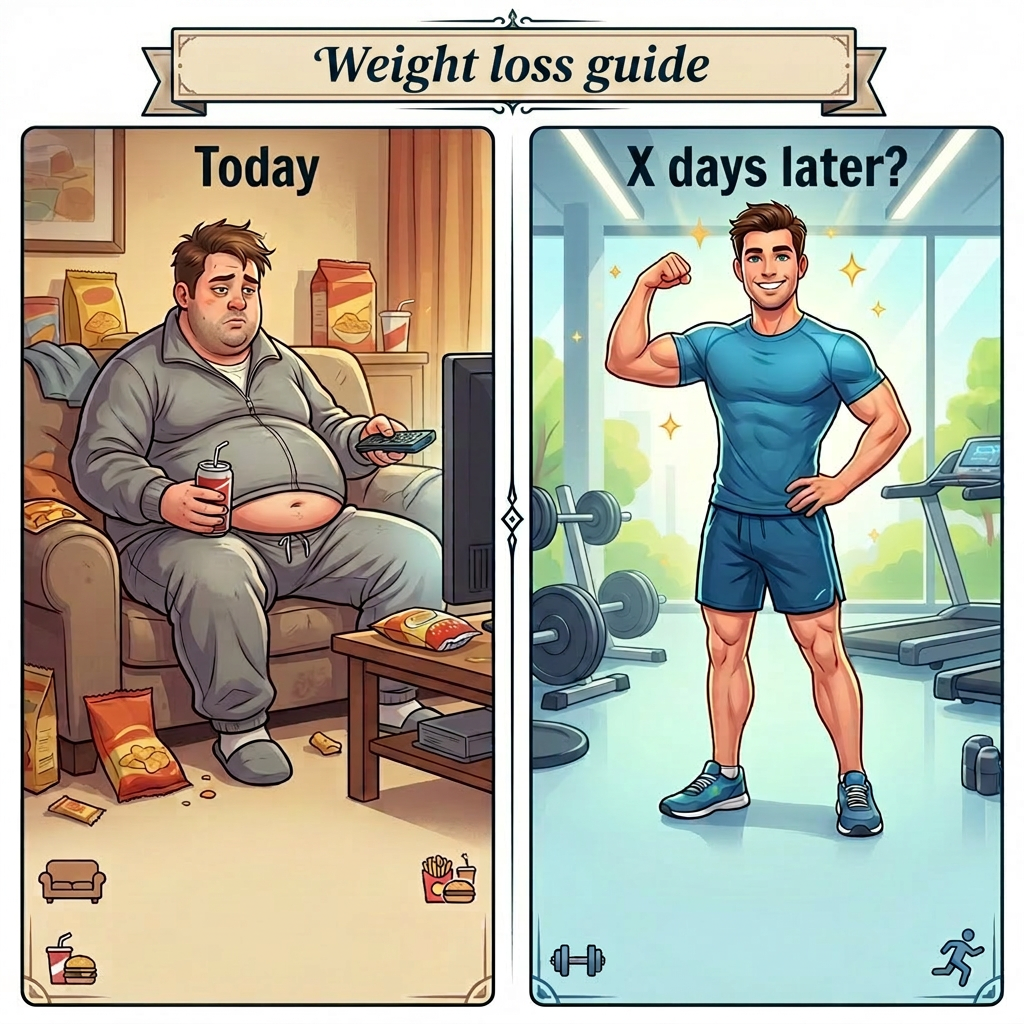

You want to lose weight. You have no idea where to actually start. The internet has 10,000 guides. Some tell you to cut carbs. Some tell you to cut fat. Some tell you calories don’t matter. Some tell you that timing is everything. The supplement ads promise the hard part is over if you just take their pill.
None of it is consistent, most of it is wrong, and by the time you finish reading all the conflicting advice, you’ve talked yourself out of even trying.
This guide cuts through that. No supplements. No extreme approaches. Just four fundamentals, a simple action plan, and enough context to understand why you’re doing what you’re doing. You’ll be able to start this week. You’ll understand the science behind why it works. And you’ll have a plan that actually matches real life instead of some Instagram fitness coach’s idea of “dedication.”
If you just want the action steps, skip to the action plan section at the bottom.
The One Thing That Actually Matters for Weight Loss
Thousands of diets exist. Keto, Paleo, Vegan, Intermittent Fasting, IIFYM, Mediterranean, Carnivore, Low-Carb, Low-Fat, Low-Calorie, High-Carb, Time-Restricted Eating, Zone, Atkins, Weight Watchers, Noom, and on and on.
You know what they all have in common? They only work if they help you eat fewer calories than you burn.
That’s it. Every successful weight loss diet — regardless of the brand, philosophy, or marketing — works because it creates a caloric deficit. Some do it by restricting carbs (which naturally reduces food volume). Some do it by restricting fats (ditto). Some do it by restricting when you eat. Some do it by restricting what you eat. But all of them work by reducing total calories below what you burn.
💡 The fundamental mechanism of weight loss:
Fat loss requires a caloric deficit. Your body weight is determined by the balance of calories in vs. calories out. When calories in < calories out consistently, your body pulls energy from stored fat. That’s the entire mechanism.
Before you read another word about macros, meal timing, or supplements, understand this: the diet that works is the one that helps you create a deficit and stick with it. Not the trendiest diet. Not the one that “matches your body type.” The one you’ll actually follow.
Everything else in this guide is about how to create that deficit in a way that’s sustainable for actual human beings. Without causing any health problems (Yes, drastic and uncontrolled changes can be negative)
Fundamental 1: Create a Caloric Deficit (Not a Disaster)
Your body burns a certain number of calories per day. This number is called your Total Daily Energy Expenditure (TDEE). It’s made up of three things:
- Basal Metabolic Rate (BMR): Calories burned at rest just to keep your body alive (breathing, heartbeat, brain function, etc.)
- Thermic Effect of Food (TEF): Calories burned digesting food (~10% of total TDEE)
- Activity Energy Expenditure (AEE): Calories burned from exercise and daily movement
To lose fat, you need to eat fewer calories than your TDEE. Simple math.
But here’s where most people get it wrong: they create deficits that are way too aggressive.
A 2016 meta-analysis found that deficits beyond 500-750 calories per day led to more muscle loss and increased metabolic adaptation, actually making weight loss *slower* over time. (Garthe et al., 2011)
Start here:
- Estimate your TDEE using an online calculator (there are dozens; search “TDEE calculator”)
- Subtract 300-500 calories from that number. That’s your target intake.
- Eat that amount consistently for 2-4 weeks.
- If you’re not losing weight at a rate of 0.5-1 lb per week, reduce by another 100 calories and wait 2-4 weeks again.
You’re looking for the sweet spot where you’re in a consistent deficit *and* the diet is sustainable. Too aggressive and you’ll abandon it. Too small and you won’t see results.
Fundamental 2: Get Enough Protein
Here’s the hard truth: when you lose weight, you don’t just lose fat. You also lose muscle. The amount of muscle you lose depends largely on how much protein you eat and whether you do resistance training.
A 2016 meta-analysis in the Journal of the International Society of Sports Nutrition found that higher protein intake during a diet preserved significantly more muscle than lower protein intake. The effect was even more pronounced with resistance training. (Morton et al., 2018)
Why does this matter? Because muscle mass directly affects your metabolic rate. Lose muscle, and losing weight becomes harder in the future.
Start here:
- Calculate your target: 0.7-1.0 grams per pound of body weight (if you weigh 180 lbs, that’s 126-180g protein per day)
- Spread it throughout the day. It doesn’t have to be exactly even across meals, but getting it distributed helps with satiety.
- Protein-rich foods: chicken, turkey, fish, eggs, Greek yogurt, cottage cheese, beef, beans, tofu.
This single change — hitting your protein target — will make weight loss feel easier. You’ll be less hungry, you’ll preserve more muscle, and your workouts will feel stronger.
Fundamental 3: Move Your Body (With Some Intention)
Exercise isn’t required for weight loss. A caloric deficit from diet alone will produce fat loss. But exercise adds three critical benefits:
- Muscle preservation: Resistance training signals your body to keep muscle during a deficit
- Metabolic improvements: Strength training increases metabolic rate independent of weight loss
- Sustainability: Exercise improves mental health, energy, and adherence to the diet
A meta-analysis comparing diet-only to diet + exercise found equivalent short-term fat loss, but the exercise group had better cardiovascular health, preserved more muscle, and had higher long-term adherence. (Sacks et al., 2009)
Start here:
- Resistance training: 2-3 days per week, 20-30 minutes per session. Push, pull, squat, hinge movements. Even bodyweight is fine at the start.
- Cardio: Optional. If you like it, add 20-30 minutes of low-intensity walking or biking on non-lifting days. If you hate it, don’t do it.
- Daily movement: Aim for 7,000-10,000 steps per day. Just walk more throughout your day.
You don’t need to kill yourself in the gym. You need to do something consistently, and resistance training is the non-negotiable piece because it preserves muscle while you lose fat.
Fundamental 4: Actually Stick With It
This is the hardest part, and no amount of science changes that. Most people can create a deficit for a week. Few can do it for months. Almost nobody does it long enough to see real results.
Why? Because caloric deficit, by definition, means slight deprivation. Your body wants more food than you’re giving it. Your brain wants the pleasure of unrestricted eating. Your social life pushes back against dietary restrictions.
The people who succeed aren’t the ones with the most willpower. They’re the ones who structure their diet to be as sustainable as possible.
A 2016 study found that people who attempted moderation in their diet (80% compliance) lost more weight over 12 months than those who attempted perfection and gave up after 3 months, even though the perfectionists had higher short-term losses. (Verstuyf et al., 2016)
Start here:
- Choose foods you actually like. The diet of grilled chicken and broccoli works if you love those foods. If you hate them, you won’t stick with it. Build your deficit around foods you enjoy.
- Allow flexible meals. If your target is 2,000 calories, one of those meals can be “whatever you want” within reason. This isn’t cheating; it’s sustainability.
- Plan for obstacles. You’ll eat more on holidays. You’ll miss workouts sometimes. Plan for this. Accept that 80% consistency is enough.
- Track progress multiple ways. The scale is one data point. Track how you look, how clothes fit, energy levels, and strength gains. Weight fluctuates daily; these are more reliable.
- Adjust the diet when it stops working. After 4-6 weeks at your calorie target, your body adapts. If weight loss stalls, reduce calories by another 100-150 and wait another 4 weeks. Don’t go lower than 1,200 calories per day without professional guidance.
The goal here is to design a lifestyle, not a diet. Something you can do for years, not something you white-knuckle for 12 weeks and then abandon.
Your Action Plan
Week 1:
- Calculate your TDEE (Google “TDEE calculator”)
- Set your calorie target: TDEE – 400
- Calculate your protein target: Your weight in lbs × 0.8
- Pick a calorie tracking app (MyFitnessPal, Cronometer, LoseIt, etc.) and log everything you eat for 7 days
- Find a simple resistance training program (r/fitness has a wiki with beginner programs; search “beginner lifting routine”)
Week 2-4:
- Follow your calorie and protein targets as closely as you can (~80% accuracy is enough)
- Do your resistance training 2-3 times per week
- Increase daily walking (aim for 8,000 steps)
- Weigh yourself every day, but only record weekly averages (weight fluctuates a lot day-to-day)
Week 4+:
- Check your weight loss: you’re looking for 0.5-1 lb per week loss
- If losing: keep going. Reduce calories by 100 if weight loss slows down.
- If not losing: reduce calories by 100-150 and try again for 4 weeks
- Every 12 weeks, reassess your TDEE (it lowers as you lose weight) and adjust your target down
One More Thing
You’re going to hear a lot of noise. Someone will tell you that you’re doing it wrong because you’re not doing keto. Or carnivore. Or intermittent fasting. Or because you’re eating carbs after 6 PM. Ignore them.
If you’re consistently in a caloric deficit, eating enough protein, and doing resistance training, you’re doing everything that scientifically matters. Everything else is details and personal preference.
The diet that works is the one that:
- Creates a consistent deficit
- Is sustainable for you
- You’ll stick with for months, not weeks
Do that, and the rest figures itself out. Continue reading Wellthify’s weight loss series to get the ideal physique, fitness and active body that you desire.


Leave a Reply