Address
304 North Cardinal St.
Dorchester Center, MA 02124
Work Hours
Monday to Friday: 7AM - 7PM
Weekend: 10AM - 5PM

Address
304 North Cardinal St.
Dorchester Center, MA 02124
Work Hours
Monday to Friday: 7AM - 7PM
Weekend: 10AM - 5PM

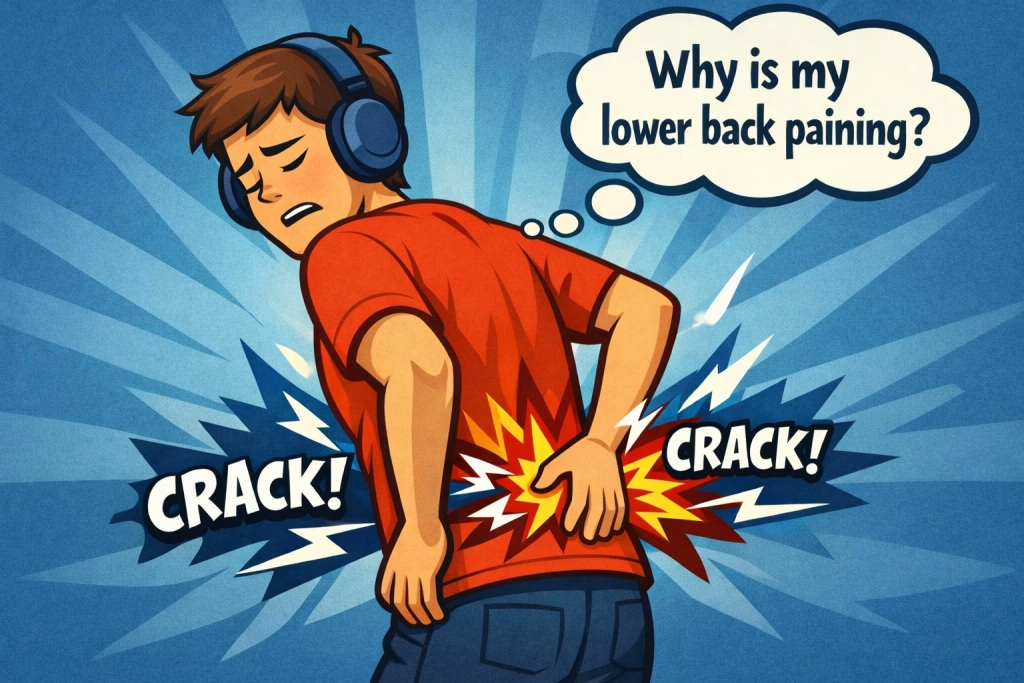
Lower back pain doesn’t feel the same for everyone. Some people describe it as a dull, heavy ache. Some feel a sudden sharp “catch.” Others say it burns or shoots down the leg. And that difference matters. Because the way your pain feels is often the first clue about what your body is dealing with. Let’s break it down in a way that actually helps you recognize your own pattern.
Most people treat all back pain the same way. They either ignore it, or think laying down for ever will fix it. Or panic and assume something serious. But different types of lower back pain usually respond to different approaches. For example:
Clinical research consistently shows that early self-management decisions influence recovery outcomes in lower back pain. People who stay moderately active and understand their pain pattern tend to recover faster than those who avoid movement out of fear. Knowing what type of pain you’re dealing with helps you:
Knowledge is never a replacement for medical diagnosis. But it turns confusion into clarity and will help you better explain your situation to your doctor.
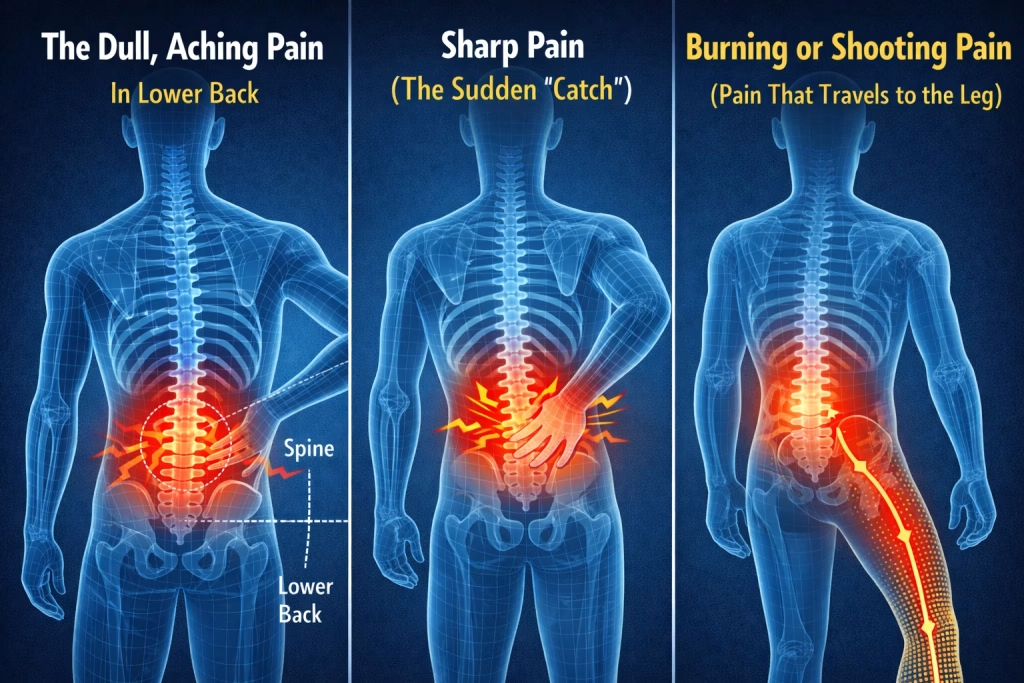
This is the type most people live with quietly. It feels heavy. Sore. Sometimes just “tired.” It usually stays in the lower back and doesn’t travel anywhere.
You might notice it:
This type of pain is very often muscular. Here’s what’s happening underneath.
When you sit for long periods, the deep muscles that support your spine reduce their activity. They’re meant to stabilize you through small, constant adjustments — but sitting still switches that system off. At the same time, the pressure inside the discs (the soft cushions between your spine bones) increases when you slouch.
Studies measuring spinal disc pressure show that sitting in a flexed (slouched) position increases load compared to standing upright. That increased load, combined with low muscle activity, creates fatigue and stiffness over time. So that “heavy” could be muscle fatigue plus mechanical pressure.
The good news? This type of pain is usually temporary and very responsive to:
An office worker who adds hourly movement and improves posture often sees noticeable improvement within a few weeks. This is the most fixable category of lower back pain.
This one gets your attention immediately. You bend, twist or lift something and suddenly — a sharp stab.
It may feel like something “pulled” or “caught.” This type of pain is commonly caused by a muscle strain or ligament irritation. A sudden movement places more load than the tissue was prepared for, and tiny fibers overstretch. Your body responds instantly.
When muscles detect sudden strain, they tighten reflexively to protect the area. That protective spasm can actually increase pain temporarily — not because damage is severe, but because your body is guarding itself. That’s why movement feels restricted right after.
In most cases, sharp mechanical pain improves within days to a few weeks if you:
Clinical guidelines consistently show that prolonged bed rest actually slows recovery for acute lower back pain. Gentle activity tends to speed it up. Sharp doesn’t automatically mean serious. It usually means overloaded.
This feels very different from the first two. People describe it as:
And often it travels from the lower back into the buttock or down the leg. When pain travels like that, a nerve is usually involved. (Nerves are the message wires that carry signals from your brain to your legs.)
Sometimes a disc bulge or inflammation irritates one of these nerves. When a nerve gets irritated, it doesn’t just complain locally — it sends signals along its entire path. That’s why pain can travel.
Research shows that even small disc bulges are extremely common on MRI — including in people with no pain at all. This means imaging findings don’t always equal serious damage. Many nerve-related symptoms improve over time as inflammation settles.
That’s important to know because people often panic when they hear “disc.” While this type needs more attention than muscular ache, many cases improve with:
However, if this type of pain comes with leg weakness, loss of bladder control, or severe numbness, medical evaluation is important. Most cases? They improve gradually.
This one confuses people. You wake up stiff. Your back feels tight. After 10–20 minutes of moving, it improves. So what’s going on here? During sleep, your muscles relax and joints stay still for hours. If your lower back muscles are weak or tight, that stillness makes them feel stiff when you first move.
Movement increases blood flow to muscles and stimulates joint lubrication. That’s why stiffness reduces after you start walking around. Morning stiffness that improves with movement is usually mechanical — related to muscle tightness, inactivity, or mild age-related joint changes.
It’s often more about conditioning than disease.
Most lower back pain falls into this category. Generally reassuring signs:
Global health data shows that the majority of low back pain cases are classified as “non-specific,” meaning no dangerous structural cause is found. That’s actually encouraging.
Without fear — just awareness. See a doctor if:
These are less common — but important to check.
When you can identify your pattern, you:
Instead of asking, “Why is this happening to me?” You start asking, “What category does this fit into?” That shift changes everything.
If you’re now wondering: “Will this go away on its own?” “Is this temporary or long-term?” That’s exactly what we cover next:
Temporary vs Long-Lasting vs Permanent Back Problems
And if you suspect your daily routine plays a role:
Over-Use vs Under-Use: How Both Too Much and Too Little Movement Hurt Your Back
Always remember: Knowledge is never a replacement for medical diagnosis. If you experience severe or worsening pain, weakness, numbness, or changes in bladder or bowel control, seek medical evaluation promptly.
Subscribe to get the latest posts sent to your email.